Behind the Seams: The Theatrical Magic of Costume Design
By Jean Schiffman
From the fantastical world of pantomime to decades of irreverent artistic expression, Alina Bokovikoa and Beaver Bauer chat with SF/ARTS about their craft
→ "Alice in Wonderland," Presidio Theatre,
through December 27. presidiotheatre.org

The Red Queen and Alice in the Presidio Theatre's "Alice in Wonderland"
When I arrive at the Presidio Theatre, two weeks before the first rehearsal for this year’s holiday pantomime, “Alice in Wonderland,” a costume fitting is underway. Alina Bokovikoa, who has been the costume designer for every annual holiday pantomime here so far, is fussing, along with a half-dozen other women, over one of the show’s main actors, Curt Branom, who will appear in various costumes as the panto’s traditional “dame”: a male actor playing a comedic female character that’s central to the show.
Branom is in a place-holder long lavender-blue wig, a bouffant sparkly skirt with beads dangling from the hem, silver high heels, long black gloves. The costume crew drapes a stole over him, discusses the possibility of sequins on it, or perhaps a stuffed animal, or just paws and a nose. He’ll have a super-quick change backstage to transform the outfit into a frilly wedding dress.
Executive producer Peggy Haas wanders in. “You look like a giant marshmallow,” she says. The costumers discuss the length of the necessary white sleeves, and the possibility of adding tassels. “He looks like Frida Kahlo!” exclaims Bokovikoa.
“It does feel like a bit Day of the Dead,” agrees Branom.
This version of the 1865 Lewis Carroll classic is a reworking of the traditional British panto, which, seasonally turns a fairy-tale plot into a wacky musical comedy with slapstick, social satire and interactive audience participation.
Nor does this “Alice” follow the story per se. As advertised: “When a forgotten birthday sends Alice tumbling into a topsy-turvy San Francisco Wonderland, she wanders a world where the rules grow curiouser and curiouser.”
Fitting done for the day, Bokovikoa and I adjourn to another room, where books of design illustrations are laid out on a table, including work by famous 1920s-era Russian-born French fashion designer Erté. Clearly his work inspired her in this project.
Born in Ukraine and raised in Siberia, Bokovikoa emigrated to America at 30, after studying English and art in Russia. She continued her formal studies, initially in Silicon Valley (she lives in San Diego now), and considers her study of art history to be especially important in what would turn out to be a busy career.
In addition to designing for such local companies, among them, San Francisco Opera, TheatreWorks and, most recently, Word for Word’s “Assimilation,” she has also worked for theatres in Southern California, has received awards, and her designs have been exhibited in Moscow and elsewhere. Here are some excerpts from our hour-long chat.
How did you start the project?
We start construction ideally six months ahead. At first I had two drapers for a photo shoot. Then when the script, by Richard Ciccarone and Stephanie Brown, was released, we went to the costume shop at TheatreWorks and brought in more drapers for six weeks. After that we went back to two drapers. They
cut fabric, make patterns, are in charge of construction. Drapers have about five stitchers who do sewing, sometimes by hand, also by machine. There are also people focusing on craft: headpieces, complicated construction stuff.
What about designing for Alice? Our Alice is a modern girl. I envisioned her as very gentle, very feminine, but at the same time edgy. I immediately thought about the combination of ruffles and a kind of toughness. Many times for panto I start my inspiration from textiles. For example, for the Red Queen, I was searching for fabric last spring, and I saw a pattern of broken glass, so we built a costume for Rotimi Agbabiaka, who plays the role, even before there was a script. We usually go to L.A. to buy fabric, it’s the biggest resource for fabrics. I go with my draper, we see blue ruffled fabric. OK this is Alice. This is my Alice, not the original Alice. So I started little sketches.
What will Curt’s actual wig look like?
We’ve always had Marie Antoinette-inspired wigs. It'll be blue to match Alice’s dress. With 1920s curls. He is the storyteller, so he becomes different characters. Dame is known in any panto for the costumes. It’s a goal to design something unexpected. This is a play inside a play, so that’s how I decided to have a theatre inside his dress. He has a big Marie Antoinette dress, then he parts open the curtains of his skirt and reveals the stage of the theatre within.
What are the design challenges with this show, aside from the quick changes?
We’re still trying to figure out how to portray magic. One of my experiments that they wanted to do for this show is glow-in-the-dark costumes. We haven’t used that yet in our pantos. We’re experimenting with different ideas, different textiles. We want to have this dance of fireflies who actually glow in the dark, so we’re still figuring that out at the moment.
What is the most important thing your mentor, Judith Dolan, taught you?
She said, when you look at a dress, you don’t say “I like” or “I don’t like.” You don’t judge the look. Try to look at what you see there. Focus on your associations.
How many costumes will there be?
Probably about 70. We have some traditional characters from Alice in Wonderland and an ensemble of 10 dancers who, with almost every number, have new costumes.
Were you inspired by Lewis Carroll’s illustrator, John Tenniel?
Of course, but panto is a really exaggerated genre. When we were designing a human rabbit, we give him hips, something more realistic.
To what extent is the director, Liam Vincent, involved in the design of this show?
Any project, it’s always through the eyes of the director, not the costume designer. Liam is the most comfortable, intelligent director, open to new ideas. We collaborate here.
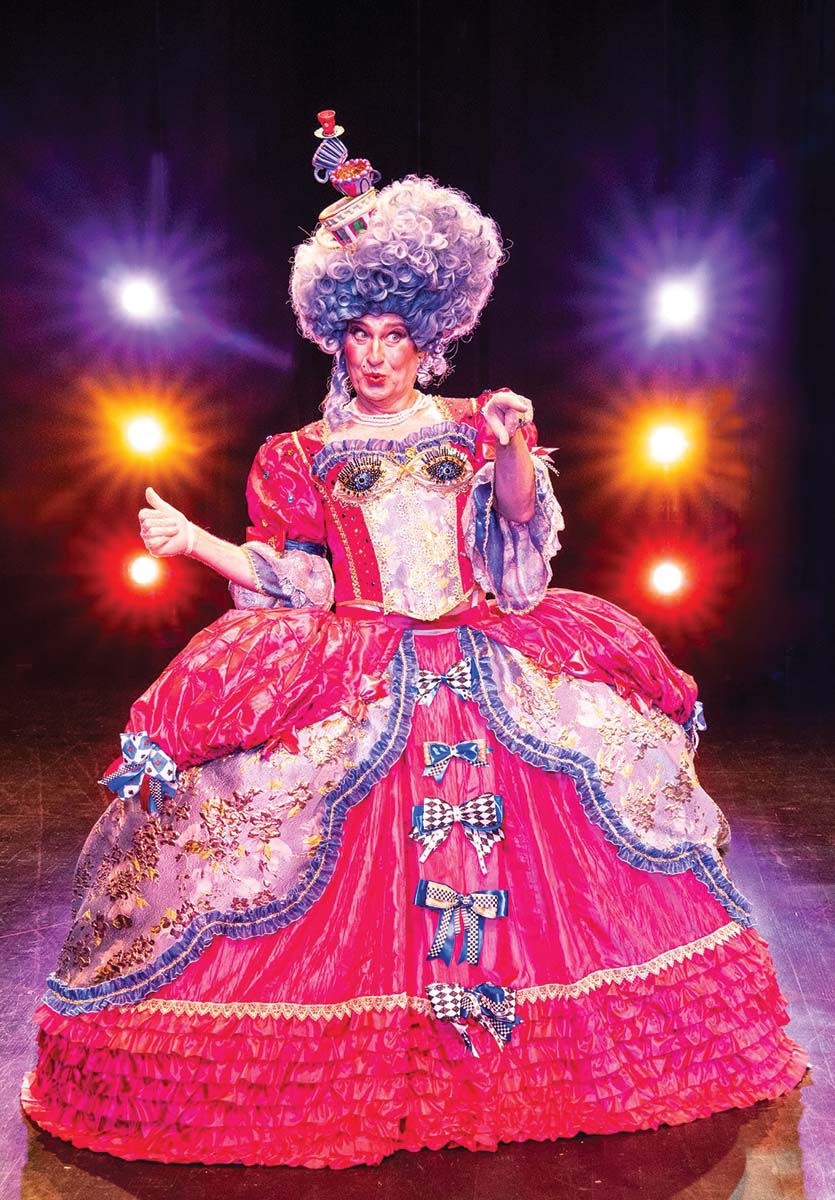
Main image: Designer Alina Bokovikoa's over-the-top creation for Curt Branom as the Dame in "Alice in Wonderland."
→ "Beaver Bauer: From Street to Stage," through April 11 at the San Francisco Main Public Library.
sfpl.org

Beaver Bauer's intricate costume for “A Christmas Carol,” as worn by Dan Hyatt.
From a horse-crazy Ohio teenager who loved to draw to Haight hippie to outrageous and brilliant costume designer, Debra “Beaver” Bauer is a bit of a San Francisco theatre legend. Locally, she has worked for companies large (such as American Conservatory Theater) and small (Theatre of Yugen) and everything in between and has been known for decades as our preeminent costume designer.
She is currently having her first major exhibit, “Beaver Bauer: From Street to Stage,” a 50-year retrospective of her work from present day back to when she was drafted into the radical gender-bending1970-84 performance collective, Angels of Light Free Theatre, by founder George Harris Jr., aka Hibiscus.
The show is co-curated by Mark D. Johnson, Trisha Lagaso Goldberg and Theo B. Lau. Beaver Bauer costume designs — outrageous, exquisite, witty — have appeared on stages from Washington DC to New York City to Las Vegas. She has designed for the Brian Boitano Skating Spectacular on NBC TV, and was resident designer for Teatro ZinZanni in San Francisco, Chicago and Seattle.
Much of her work is on display in this exhibit: full costumes, photographs, sketches, masks (a particularly striking mandrill) and headdresses (one is an elegant sculptural toilet), video clips. A glass case filled with semi-used makeup. Jewelry and glitter and sequins. An exotic Mme. ZinZanni gown with rhinestones, jewelry, brocade and dried pheasant, coque and ostrich feathers.
In the lobby, an installation features Bauer’s “tree of life” painting, its design inspired by the willow tree, which, she says, is related to resilience and rebirth. It commemorates her many colleagues who died of AIDS/HIV.
Bauer says it’s contrary to her personality to promote herself, but she realized, a while back, that she wanted to do a show and knew she’d have to initiate it herself, as “No one was going to ask me!” A space with free admission was a non-negotiable choice for Bauer and her sights settled on the San Francisco Public Library.
“My mother and I loved the library and I've always found it a place of fertility and safety.” She says that “a curator carefully and thoughtfully put it into shape, tried to give me context and a through line.” That curator was Johnson, an art historian, curator and professor emeritus at San Francisco State, who first met Bauer in 1991 but had attended performances of the Angels of Light back in the day, among many other theatres of that era, and knew well of her luminous career. The costumes in this exhibit, he says, are an important part of San Francisco art that does not fit into commercial galleries.
Among the costumes on display, Bauer guesses about 20% are from the period when she was living with the Angels in various communes in the Haight and performing with them at theatrical venues as well as at old folks’ homes, bars and more. Each elaborate Angels costume was unique, created for one performance only.
“Clothing and transforming yourself is fun and releases something in you,” says Bauer. “I hope I’ve made something funny and inspiring for even one person. That is my goal.”